Considerations in sulfonamide hypersensitivity
Sulfonamide hypersensitivity is common. There is cross-reactivity between sulfonamide antibiotics.
There are also non-antibiotics which contain a sulfonamide chemical group (“non-antibiotic sulfonamides”). Evidence indicates that patients allergic to sulfonamide antibiotics do not cross-react to non-antibiotic sulfonamides. Even so, manufacturers often contraindicate non-antibiotic sulfonamides in people with sulfonamide hypersensitivity.
Avoiding all non-antibiotic sulfonamides may be impractical. We advise on:
- which UK-licensed drugs have a sulfonamide or related group
- evidence for lack of cross-reactivity between sulfonamide antibiotics and non-antibiotic sulfonamides
- evaluating risk and choosing a medicine for a patient with sulfonamide hypersensitivity
Sulfonamide drugs licensed in the UK
The following drugs with a sulfonamide group are licensed in the UK. Others may be available worldwide.
Sulfonamide antibiotics
These include:
- sulfamethoxazole (in co-trimoxazole)
- sulfadiazine
- sulfapyridine (in sulfasalazine)
Non-antibiotic sulphonamides
Classes where all members have a sulfonamide group include:
- carbonic anhydrase inhibitors
- loop diuretics
- sulfonylureas
- thiazides and thiazide-like diuretics
Individual drugs with a sulfonamide group include:
- antivirals: fosamprenavir and darunavir
- BRAF inhibitors: dabrafenib, encorafenib, and vemurafenib
- COX-2 inhibitors: celecoxib and parecoxib
- rosuvastatin
- sotalol
- sulfasalazine (contains the sulfonamide antibiotic sulfapyridine)
- tamsulosin
- topiramate
- triptans: almotriptan, naratriptan, and sumatriptan
- zonisamide
Sulfonamide structure
Sulfonamides are drugs which include a sulfonamide group.
Structure of sulfonamide group

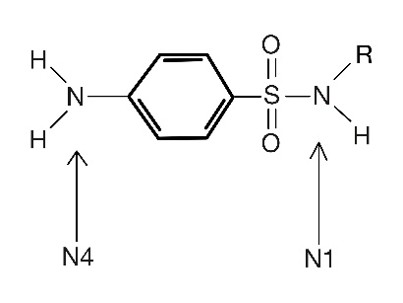
The antibiotic sulfonamides (and the antivirals fosamprenavir and darunavir) have an arylamine group at the N4 position. They usually also have a five- or six-member heterocyclic aromatic ring with one or more nitrogens at the N1 position. The non-antibiotic sulfonamides lack these groups.
Sulfonamide antibiotic structure, with N1 and N4 marked
Sulfonamide hypersensitivity mechanisms
Sulfonamides can cause all four types of hypersensitivity reaction. The sulfonamide group itself is not responsible; other parts of the drug molecule cause reactions.
Type I immediate IgE-mediated reactions
Type I reactions include urticaria, hypotension, angioedema, and anaphylaxis.
The parts of the molecule responsible for type I reactions are the arylamine group at the N4 position and the heterocyclic aromatic ring structure at N1 position.
Types II-IV delayed reactions
Metabolites are probably involved in non-IgE-mediated reactions, not the original molecule. Hydroxylation at N4 and further metabolism produces highly reactive nitrososulfonamides. These bind to T-lymphocytes or native proteins, inducing subsequent type II, III, or IV immune responses.
Type IV (T-cell-mediated) reactions, such as non-urticarial maculopapular rashes, are the commonest sulfonamide hypersensitivity reactions. Severe reactions such as Stevens-Johnson Syndrome (SJS), toxic epidermal necrolysis (TEN), or drug-induced hypersensitivity syndrome (DRESS) may also occur.
Sulfonamide cross-reactivity
Cross-reactivity requires immune recognition of a similar molecule: the drug, a metabolite, or a drug-carrier protein complex. If a person reacts to two drugs but the molecules or the reactions are different, cross-reactivity is unlikely.
People hypersensitive to one drug are at increased risk of reacting to an unrelated drug. This is not cross-reactivity, even if the reactions are similar.
Cross-reactivity between antibiotic sulfonamides
The structural groups associated with sulfonamide antibiotic hypersensitivity reactions are the arylamine group at N4 and the heterocyclic ring at N1. As these are shared by the antibiotic sulfonamides, cross-reactivity is expected.
Cross-reactivity between antibiotic and non-antibiotic sulfonamides
Non-antibiotic sulfonamides usually lack the arylamine group at N4 and the heterocyclic ring at N1 that cause sulfonamide hypersensitivity reactions. Cross-reactivity between antibiotic and non-antibiotic sulfonamides is not expected, including in people who had a life-threatening reaction to a sulfonamide.
Existing case reports of alleged cross-reactivity between antibiotic and non-antibiotic sulfonamides do not provide convincing evidence of broad cross-reactivity.
Cross-reactivity between non-antibiotic sulfonamides
There is no evidence of cross-reactivity between different classes of non-antibiotic sulfonamides.
Prescribing in sulfonamide hypersensitivity
Avoiding all drugs with a sulfonamide group in people with a sulfonamide hypersensitivity is not advisable. It can lead to inappropriate use of alternatives with reduced efficacy or increased adverse effects.
Prescribing sulfonamide antibiotics
People hypersensitive to a sulfonamide antibiotic should avoid other sulfonamide antibiotics.
If a sulfonamide antibiotic is needed, challenge testing or desensitisation may be possible.
Prescribing sulfonamide non-antibiotics
American AAAAI/ACAAI guidance states that there is minimal concern for cross-reactivity with sulfonamide non-antibiotics in people with a history of reactions to sulfonamide antibiotics. Even so, non-antibiotic sulfonamide product information often contraindicates use in people with sulfonamide antibiotic hypersensitivity.
It may be preferable to use a suitable non-sulfonamide alternative if one is appropriate. However, prescribing a sulfonamide-containing drug may be in the patient’s best interests. Follow the GMC’s guidance on unlicensed and off-label prescribing.
If no suitable non-sulfonamide option is available, consider the following guidance.
People who had a reaction to a non-antibiotic sulfonamide
There is no reason to avoid antibiotic or non-antibiotic sulfonamides from a different class if a person has experienced a hypersensitivity to one non-antibiotic sulfonamide.
Drugs needing special consideration
Some non-antibiotic sulfonamides and other drugs have additional considerations.
Fosamprenavir and darunavir
Fosamprenavir and darunavir have an arylamine group at N4. Evidence of cross-reactivity between sulfonamide antibiotics and these antivirals is lacking, but caution is sensible.
If possible, avoid these antivirals in people who have had a serious hypersensitivity reaction to a sulfonamide antibiotic.
Dapsone
Dapsone is a sulfone, but has an arylamine group. Up to 20% of people sensitive to sulfonamide antibiotics also react to dapsone, but most tolerate it without issues.
Even so, people who have had a serious reaction to a sulfonamide antibiotic should avoid dapsone if possible.
BRAF-inhibitors
Dabrafenib, encorafenib, and vemurafenib contain a sulfonamide group.
In a report of vemurafenib-induced TEN, lymphocytes from people with cutaneous reactions to sulfamethoxazole reacted to vemurafenib and dabrafenib.
Even if this is not true cross-reactivity, BRAF inhibitors are associated with severe cutaneous adverse reactions such as TEN and SJS. Caution may be warranted.
Trimethoprim
Trimethoprim is not a sulfonamide, but co-trimoxazole contains both sulfamethoxazole and trimethoprim.
Hypersensitivity to trimethoprim is rare but occurs. If a person has a severe hypersensitivity reaction to co-trimoxazole, they should also avoid trimethoprim unless they are known to be tolerant to it.
Sulphur, sulphite, and sulphate allergy
It is important to distinguish between sulfonamides, sulphur, sulphites, and sulphates.
Sulphur
Elemental sulphur is essential to life. Allergy to sulphur is unlikely.
Sulphites
Sulphites are preservatives and antioxidants, and contain the anion SO32-.
Sulphite allergy usually causes allergic contact dermatitis, but can cause immediate hypersensitivity reactions.
There is no connection between sulfonamide hypersensitivity and sulphite hypersensitivity.
Sulphates
Sulphates are salts of sulphuric acid containing the SO42- ion. They are not the same as sulphites or sulfonamides. Sulphate allergy is very unlikely, if it exists at all.
Update history
- Republished
- Full review and rewrite. Information on which drugs are sulfonamides, structure, allergy mechanisms, and specific prescribing advice added.
- Published