Safety concerns
The Medicines and Healthcare products Regulatory Agency (MHRA) has issued multiple safety communications highlighting the risk of QT interval prolongation with commonly used medicines.
A prolonged QT interval on an electrocardiogram (ECG) increases the risk of life-threatening arrhythmias including torsade de pointes (TdP).
There is no exhaustive list of medicines prolonging QT interval.
Our step-wise approach supports the identification and management of medicines associated with QT interval prolongation.
Understanding QT interval
The QT interval represents the time from the start of ventricular depolarisation to the end of ventricular repolarisation. It reflects how long the ventricles take to activate and then recover electrically before the next beat.
Measurement
The QT interval is measured in milliseconds (ms), using an ECG.
The QT interval varies with heart rate. It is corrected and expressed as the QTc interval.
Normal ECG QTc intervals
- Men: up to 450 ms
- Children, adolescents and women: up to 460 ms
- Full term neonates: up to 470 ms
QT interval prolongation
Symptoms
Many people with QT interval prolongation do not have any symptoms.
Some may present with palpitations, syncope or presyncope, angina.
Others may also present with symptoms of reduced cardiac output, such as cold and clammy extremities, fatigue, listlessness, poor effort tolerance, dizziness, and oliguria.
Any suspicion of QT interval prolongation should be confirmed with an ECG.
ECG QTc findings suggestive of QT interval prolongation
The following ECG QTc interval findings may indicate QT prolongation:
- Indicative: an absolute increase of 20ms or above from baseline
- Men: between 450 to 500 ms
- Children, adolescents and women: between 460 to 500 ms
- Full term neonates: between 470 to 500 ms
High risk QTc readings
A QTc interval of more than 500 ms is associated with an increased risk of TdP
Risk factors
These can be divided into patient and medicine risk factors.
Patient risk factors
Categorised as modifiable and non-modifiable.
Most clinical cases of drug induced QT prolongation occur in the presence of at least one of these risk factors.
Non-modifiable risk factors
These could increase the risk of QT interval prolongation:
- age over 65 years
- congenital long QTc interval syndrome
- family history of sudden death
- female gender at birth
- genetic variations affecting the medicine’s therapeutic or side effects
- impaired liver or kidney function
- nocturnal or undiagnosed hypoglycaemia in people with diabetes
- structural or conduction related cardiac disease such as heart failure, myocardial infarction, recent conversion from atrial fibrillation, or ventricular hypertrophy
- thyroid disease
Modifiable risk factors
The following modifiable risk factors can increase the risk of a QT interval prolongation:
- bradycardia secondary to acute condition(s)
- concurrent use of medicines that could induce QT interval prolongation
- uncorrected electrolyte disturbances such as low potassium, calcium or magnesium levels
The list is non-exhaustive. A comprehensive list of risk factors is available at the credible meds website.
Medicines risk factors
Several medicines can cause QT interval prolongation. They may act directly on cardiac ion channels, cause electrolyte disturbances, or result in pharmacodynamic interactions.
Direct effect on the heart
Medicines may exert a direct effect on cardiac ion channels, resulting in delayed cardiac repolarisation and QT interval prolongation.
The effects and associated risk are not confined to specific therapeutic classes and cannot be reliably predicted from pharmacological action alone. The degree of QT interval prolongation is also influenced by dose and systemic exposure.
The risk can be stratified according to the degree of QTc interval prolongation associated with the medicine(s).
- low risk: less than 10 ms QTc increase from baseline
- moderate risk: 10 to 20 ms QTc increase from baseline
- high risk: more than 20 ms QTc increase from baseline
Electrolyte disturbances
Diuretics and chronic use of laxatives could contribute to excessive fluid and electrolytes losses, leading to hypokalaemia, hypomagnesia, and hypocalcaemia.
Pharmacodynamic interactions
Using two or more medicines which cause QT interval prolongation can have additive effects.
Several medicines can also inhibit the key metabolic enzymes involved in the breakdown of QT interval prolonging medicines. This increases and prolongs the QT interval prolonging effects.
For example, erythromycin and escitalopram can both prolong the QTc interval. In addition, erythromycin inhibits CYP3A4, which may increase escitalopram exposure and further increase the risk of QTc prolongation.
Assessing and managing the risk in practice
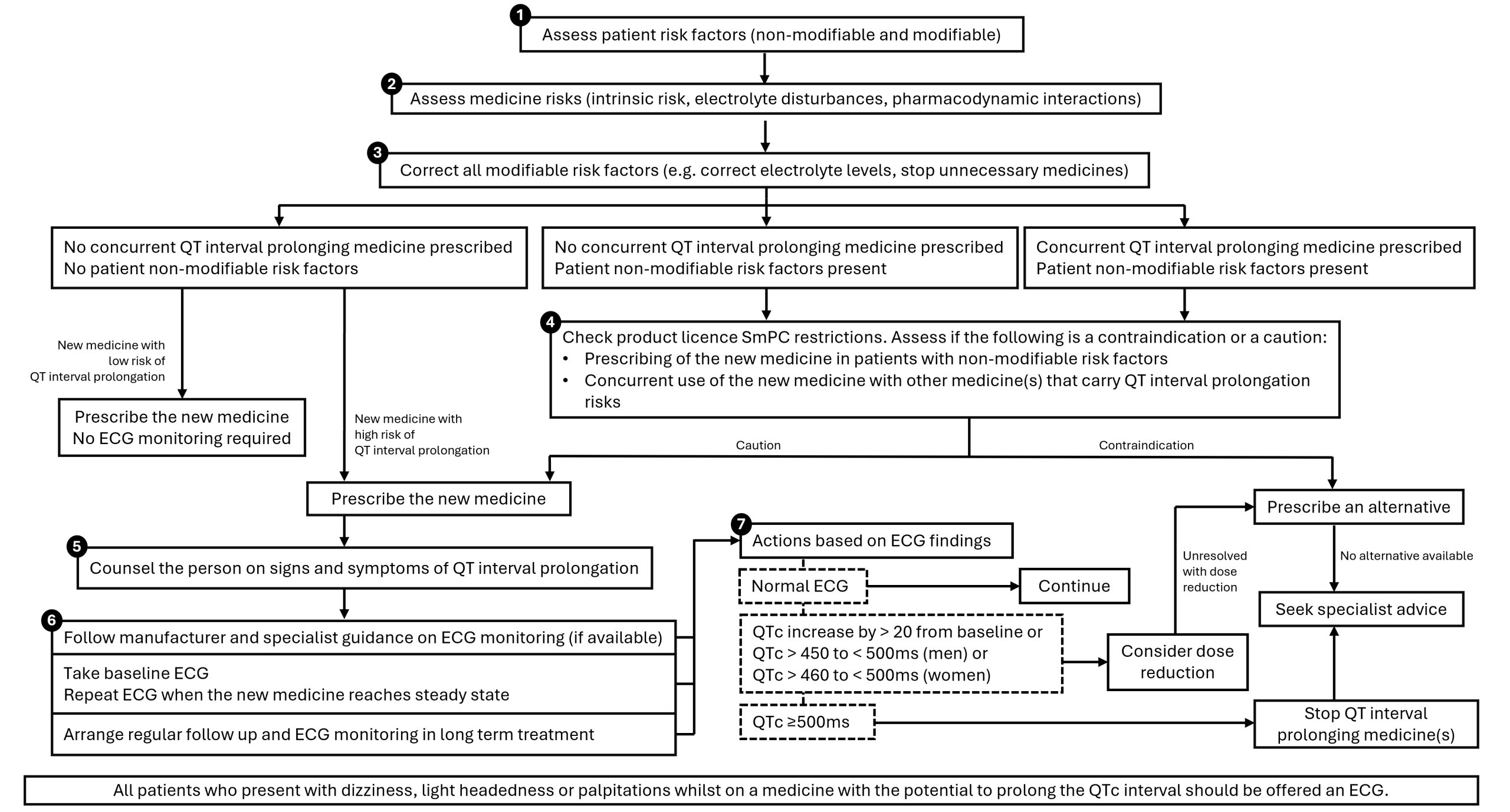
The following diagram and step-wise process advises on the assessment and management of medicine QT interval prolongation risk.
Example medicines
The following article discusses how to manage risks associated with medicines known to prolong the QT interval.
Commonly used medicines associated with QT interval prolongation
Update history
- Terminology of electrocardiogram (ECG) corrected. Removal of the recommendation to stop QT-prolonging medicines based solely on a QTc increase of >60 ms. The recommendation regarding dose reduction changed to “consider reducing the dose” to reflect the need for clinical judgement and consideration of individual patient factors. Diagram updated to align with the revised wording and recommendations.
- Republished
- Article expanded to include QT limits, a stepwise approach to patient and medicine risk assessment, and guidance on monitoring and risk management. A list of example medicines is provided in a separate article.
- Published