Explaining the terms used in this article
In Good Manufacturing Practice (GMP), the terms qualification and validation are closely related but serve distinct purposes.
Qualification is the documented process of proving that the clean room, its systems (for example, HVAC, HEPA filters, pressure differentials) and equipment function correctly and meet predefined specifications.
Validation is the broader process of proving that the entire aseptic manufacturing process, including personnel, equipment, procedures, and environment, consistently produces the desired outcome.
A Validation Master Plan (VMP) describes the entirety of the designing, building, qualification and validation processes.
Further information about qualification is available in Annex 15 to EU GMP.
Planning for qualification
The article on planning the new build (SPS page) describes the importance of preparing for the considerable workforce resource needed during the qualification stages.
It is also very important to liaise with your QC service to plan for the large numbers of environmental samples and physical testing that will be needed for the qualification of the suite. Discussions with the QC team are essential to agree an achievable qualification timetable including reporting timelines.
The practical delivery of the VMP is typically planned by the preparation of a Commissioning, Qualification & Validation (CQV) execution plan.
Understanding the Validation Master Plan
The Validation Master Plan (VMP) should be developed collaboratively by the commissioning team at the start of the project to guide planning and ensure GMP compliance. It defines roles, responsibilities, timelines, and the scope of validation activities, including quality risk assessments and qualification protocols.
The VMP:
- informs the business case by outlining the resources needed to support the project (time, staffing and financial costs)
- defines the scope of validation activities and outlines the execution methodology
- sets the criteria for acceptance
The VMP is a ‘living’ document that remains central to all future requalification, including after maintenance or shutdowns. All subsequent requalification should align with the VMP and the parameters set at commissioning. This enables early detection of defects and the trending of potential deterioration, allowing developing issues to be rectified.
The VMP includes the following key drawings:
- floor plan
- heating, ventilation and air conditioning (HVAC) layout
- electrical plan
- plumbing and piping diagram
- elevation and section views
Understanding the qualification stages
Qualification is undertaken in distinct stages. Throughout each stage the URS is referenced to ensure compliance, and comprehensive documentation is maintained to ensure GMP and MHRA guidelines are met.
Design Qualification (DQ)
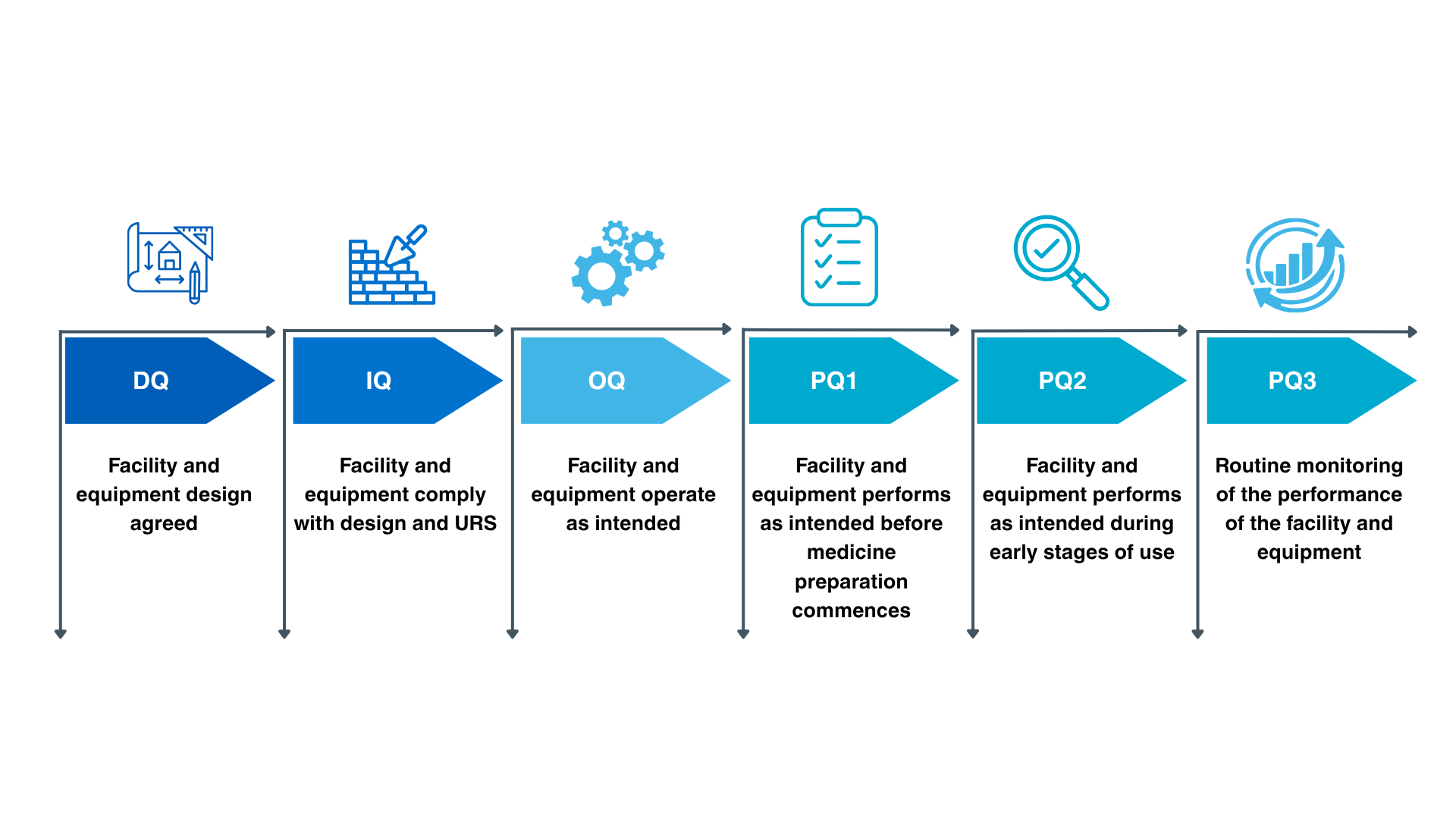
DQ ensures that the proposed design meets the URS and regulatory standards. This stage begins with a period of design review between the contractor and the commissioning and validation team. It ends with formal documentation that the final design is agreed and meets the User Requirement Specification (URS).
This process is explained in more detail in the article on design qualification (SPS page).
Installation Qualification (IQ)
Once construction is complete, IQ verifies that all equipment and systems are installed correctly and according to specifications.
Equipment to be installed may be evaluated, if applicable, at the vendor’s premises prior to delivery. This is called Factory Acceptance Testing (FAT). During FAT it should be confirmed that the equipment complies with the URS. FAT may be supplemented by the execution of Site Acceptance Testing (SAT) once the equipment is received on site to ensure functionality was not affected by transport or installation. This is particularly important when using novel, bespoke, or complex equipment.
This process is explained in more detail in the article on installation qualification (SPS page).
Operational Qualification (OQ)
OQ tests the systems under operational conditions to confirm they function as intended.
This process is explained in more detail in the article on operational qualification (SPS page).
Performance Qualification (PQ1 and PQ2)
PQ validates that the clean room consistently performs within defined parameters during routine operations.
This process is explained in more detail in the article on performance qualification (SPS page).
Routine monitoring and re-qualification (PQ3)
Equipment, facilities and systems should be evaluated at an appropriate frequency to confirm that they remain in a state of control. Following successful PQ and once the clean room suite is in use, routine monitoring and subsequent requalification begins.
The qualification stages and their relationships are described in the visual representation below.
Protocols
A validation protocol defines all critical systems, attributes and parameters and their associated pre-determined acceptance criteria. Each qualification stage requires its own protocol, agreed in advance and signed off by the commissioning and validation team.
The documentation should be designed to demonstrate traceability of critical design elements throughout the stages. Using a numbering system that enables each design element to be traced from the URS through the qualification stages is typical.
Validation protocols may be provided by a third party, but their suitability should be determined by the user before approval. If necessary, third-party validation protocols may be supplemented by additional documentation.
Any significant changes to an approved validation protocol during execution should be managed as a deviation.